Difficult Conversations: How to Protect the Relationship While Addressing What Matters
My Experience
In my experience, difficult conversations do not always get done well.
I know in my own life this is an area I have struggled with at times.
There are many reasons for that, but one of the main ones is simple: we often want to get difficult conversations out of the way as quickly as possible.
We feel the discomfort.
We know something needs to be said.
We may have carried the issue for too long.
We want the conversation finished.
But when our main goal is to get the conversation over with, we can miss the bigger purpose.
A difficult conversation is not just something to survive.
It is an opportunity to create clarity, protect trust and move the relationship forward.
That does not mean it will always feel easy. It does not mean the other person will respond exactly how we hope. But it does mean we can enter the conversation with better intention.
Dale Carnegie gives a helpful principle in How to Win Friends and Influence People, in Part Three, “How to Win People to Your Way of Thinking,” Chapter 1, “You Can’t Win an Argument.”
His message is clear: the aim is not to defeat the other person.
That is important.
If we go into a difficult conversation trying to win, the relationship may lose.
There is a useful progression:
Win/Lose:
“I need to prove I am right.”
Lose/Lose:
“I win the argument but damage the relationship.”
Carnegie approach:
“Understand their position, protect their dignity, find common ground and influence rather than defeat.”
Win/Win:
“We reach an outcome that addresses what matters while preserving or strengthening the relationship.”
This does not mean avoiding the issue.
It means entering the issue with the right posture.
At the outset, we must be clear about the outcome we desire before entering the conversation.
What actually needs to be achieved?
What needs to be understood?
What relationship needs to be protected?
What behaviour, expectation or issue needs to be addressed?
What would a constructive outcome look like?
Without clarity, difficult conversations can become emotional, rushed or reactive.
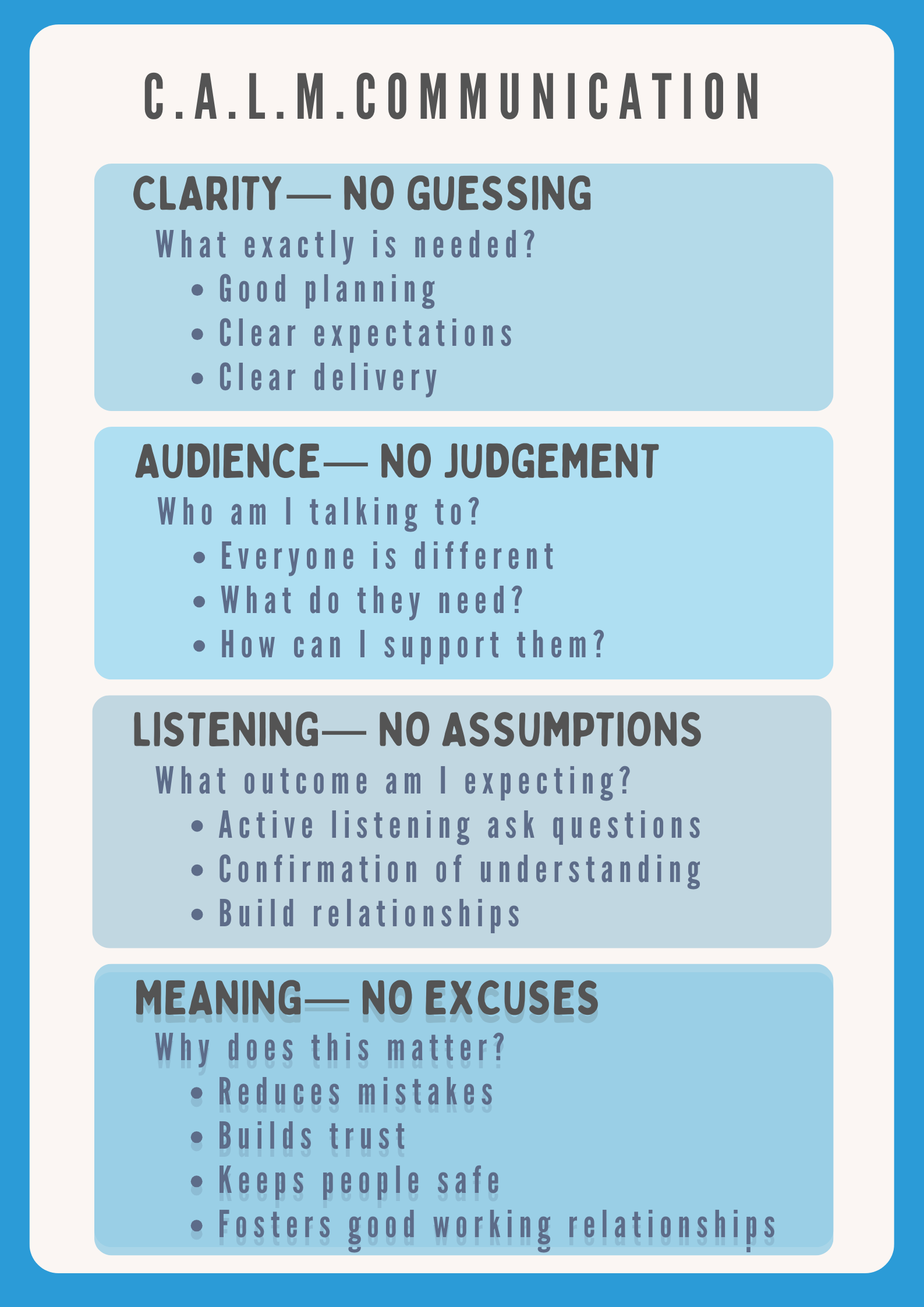
This is where the CALM Communication model is helpful.
Clarity — No Guessing
What exactly is needed?
Good planning.
Clear expectations.
Clear delivery.
Before a difficult conversation, clarity matters.
If we are unclear, we may talk around the issue rather than addressing it.
We need to know what the conversation is really about.
Is it performance?
Behaviour?
Communication?
Safety?
Follow-through?
Trust?
Expectations?
Clarity helps us stay focused.
It also helps the other person understand what is needed without having to guess.
Audience — No Judgement
Who am I talking to?
Everyone is different.
What do they need?
How can I support them?
What might they be hearing through their own frame?
This is where we need to slow down.
A difficult conversation is not just about the issue. It is also about the person receiving the message.
Some people need time to process.
Some need directness.
Some need reassurance.
Some need space to ask questions.
Some need examples.
Some need to know the relationship is still intact.
Audience does not mean we avoid truth.
It means we deliver truth in a way that can be received.
Listening — No Assumptions
What outcome am I expecting?
Active listening matters.
Ask questions.
Confirm understanding.
Build relationships.
In difficult conversations, it is easy to assume we already know the full story.
But assumptions can be dangerous.
We may have seen the behaviour, but not the reason.
We may understand the impact, but not the intent.
We may know what needs to change, but not what support is needed.
Listening does not weaken the conversation.
It strengthens it.
It helps us run assumptions to ground so we know.
Meaning — No Excuses
Why does this matter?
Difficult conversations need meaning.
Why is this important?
What could happen if nothing changes?
How does this affect the team, the work, the relationship, safety or trust?
Meaning helps people understand that the conversation is not personal attack. It is connected to something that matters.
It reduces mistakes.
Builds trust.
Keeps people safe.
Fosters good working relationships.
When people understand the meaning, they are more likely to engage with the message.
Key Lesson
Difficult conversations should not be about winning an argument.
They should be about creating clarity, protecting dignity and finding a constructive way forward.
Practical Application
Before your next difficult conversation, take five minutes and write down:
What exactly is needed?
Who am I talking to?
What assumptions do I need to check?
Why does this matter?
What outcome am I hoping for?
This does not remove the discomfort.
But it helps you enter the conversation with more purpose and less reaction.
Three Learnings
1. Be clear before you speak.
If you are unclear about the outcome, the conversation can easily drift or become reactive.
2. Protect the person’s dignity.
The goal is not to defeat the other person. The goal is to address what matters while preserving relationship where possible.
3. Listen before you conclude.
Assumptions can damage trust. Ask questions and confirm understanding before deciding you know the full story.
Conclusion
Difficult conversations are part of leadership and life.
Avoiding them can create confusion. Rushing them can create damage.
But approaching them with CALM can create clarity, trust and movement.
Clarity.
Audience.
Listening.
Meaning.
That is how we address what matters without losing sight of the person in front of us.
Famous Quote:
“The only way to get the best of an argument is to avoid it.” — Dale Carnegie
Reach Out, and let's take time to discover how we can progress together.
Remember daily to, 'Find value in your influence.' Your voice matters, and I'm excited to hear from and work with you!"